Compound Interest Is Devouring the Federal Budget: It’s Time to Take Back the Money Power

Albert Einstein is often quoted as saying that compound interest is “the most powerful force in the universe.” The quote is probably apocryphal, but it reflects a mathematical truth. Interest on earlier interest grows exponentially, outrunning the linear growth of revenue and eventually consuming everything.

That is where the United States now stands. The government does pay the interest on its debt every year, but it is having to pay it with borrowed money. The interest curve is rising exponentially, while the tax base is not.
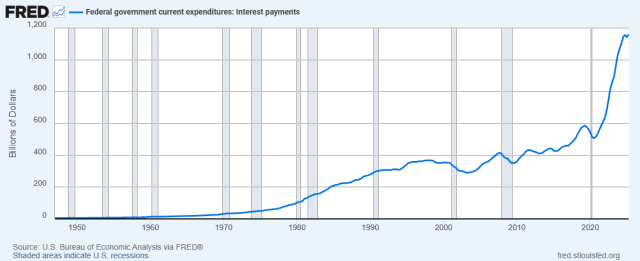
Interest is now the fastest growing line item in the entire federal budget. The government paid $970 billion in net interest in FY2025, more than the Pentagon budget and rapidly closing in on Social Security. It already exceeds spending on Medicare and national defense and is second only to Social Security. The Congressional Budget Office projects that interest will reach nearly $1.8 trillion by 2035 and will cost taxpayers $13.8 trillion over the next decade. That is roughly what Social Security will pay out over the same decade (about $1.6 trillion a year). The Social Security Trust Fund is running dry, not because there are too many seniors, but because interest payments are consuming the federal budget that should be shoring it up.

Continue reading

Why New York City Needs a Public Bank

We will build a city-owned bank — not to serve shareholders, but to serve you. A bank that invests in housing, in transit, in climate resilience. A bank that puts our money to work for our people.”
— Zohran Mamdani, Victory Speech, Nov. 4, 2025 

New York City has elected a mayor who dares to challenge the status quo. Zohran Mamdani swept into office on a platform of affordability, municipal ownership and economic justice. But Mamdani’s plan to fund his reforms through $9 billion in new taxes on corporations and high earners is already bumping up against political and fiscal realities. 

Income taxes are the province of the state, not the city, and NY State Governor Kathy Hochul is standing firm in her resistance to raising them. Pres. Trump has vowed to “cut off the lifeline” to the city, pledging to reduce federal aid to the legal minimum. And Mamdani’s proposals are said to be triggering capital flight. Wall Street is mobilizing. The city’s budget is strained. So where will the money come from?

Continue reading

How a Fed Overhaul Could Eliminate the Federal Debt Crisis, Part II: Curbing Fed Independence

There has been considerable discussion in recent years about reforming, modifying, or even abolishing the Federal Reserve. Proposals range from ending its independence, to integrating its functions into the U.S. Treasury Department, to dismantling it and returning monetary policy to direct congressional or Treasury oversight. 

The Federal Reserve Board Abolition Act (H.R. 1846 and S. 869, 119th Congress, 2025-2026), introduced by Rep. Thomas Massie in the House and Sen. Mike Lee in the Senate on March 4, 2025, calls for abolishing the Fed’s Board of Governors and regional banks within one year of enactment, liquidating Fed assets and transferring net proceeds to the Treasury. It echoes earlier efforts like Ron Paul’s 1999 bill to “end the Fed”, but the odds of its passing are slim.

Less radical are proposals to curb the independence of the Federal Reserve. Former Fed governor Kevin Warsh is considered one of five finalists to take over as chairman after Jerome Powell. In a July 17 CNBC interview, he called for sweeping changes in how the central bank conducts business, and suggested a policy alliance with the Treasury Department. 

Substantial precedent exists for that approach, both in the United States and abroad. In the 1930s and 1940s, before the Fed officially became “independent,” it worked with the federal government to fund the most productive period in our country’s history. More on that shortly.  

Continue reading

How a Fed Overhaul Could Eliminate the Federal Debt Crisis, Part I: The Fed’s Hidden Drain

The Federal Reserve’s independence is currently being challenged by political forces seeking to reshape its mandate. The Fed has not always been independent of Congress and the Treasury. Its independence was formalized only in 1951, with a Treasury-Federal Reserve Accord that was not a law but a policy agreement redefining the relationship of the parties. In the 1930s and 1940s, before the Fed officially became “independent,” it worked with the federal government to fund the most productive period in our country’s history. We can and should do that again.

In a Sept. 1 Substack post titled “Fed Faces Biggest Direct Challenge by a President Since JFK – and This Is a Good Thing,” UK Prof. Richard Werner shows that there is no evidence that more independent central banks deliver lower inflation. In fact, per his findings, central bank independence has no measurable impact on real economic performance, and greater central bank independence has resulted in lower economic growth. 

This two-part series will probe the forces in play now to overhaul the Fed, and the feasibility of redirecting it to use its tools, including “quantitative easing,” not just to save the banks but to save the economy. Part I looks at a particularly flawed Fed policy — Interest on Reserves (IOR)  — which burdens the budget, stifles liquidity, and subsidizes banks. Then it suggests ways that eliminating IOR and reining in the Fed’s independence could solve the Treasury’s interest burden altogether.

Continue reading

Unaudited Power: The Military Budget Nobody Controls

The U.S. federal debt has now passed $37 trillion and is growing at the rate of $1 trillion every five months. Interest on the debt exceeds $1 trillion annually, second only to Social Security in the federal budget. The military outlay is also close to $1 trillion, consuming nearly half of the discretionary budget.  

As a sovereign nation, the United States could avoid debt altogether by simply paying for the budget deficit with Treasury-issued “Greenbacks,” as Abraham Lincoln’s government did. But I have written on that before (see here and here), so this article will focus on that other elephant in the room, the Department of Defense.

Under the Constitution, the military budget should not be paid at all, because the Pentagon has never passed an audit. Expenditures of public funds without a public accounting violate Article 1, Section 9, Clause 7of the Constitution, which provides:

No Money shall be drawn from the Treasury, but in Consequence of Appropriations made by Law; and a regular Statement and Account of the Receipts and Expenditures of all public Money shall be published from time to time. 

The Pentagon failed its seventh financial audit in 2024, with 63% of its $4.1 trillion in assets—approximately $2.58 trillion—untracked. From 1998 to 2015, it failed to account for $21 trillion in spending. 

As concerning today as the financial burden is the wielding of secret power. Pres. Dwight Eisenhower warned in his 1961 farewell address, “In the councils of government, we must guard against the acquisition of unwarranted influence, whether sought or unsought, by the military-industrial complex. The potential for the disastrous rise of misplaced power exists and will persist.”  

Continue reading

The GENIUS Act and the National Bank Acts of 1863-64: Taking a Cue from Lincoln

This month Congress passed the GENIUS Act, an acronym for the “Guiding and Establishing National Innovation for U.S. Stablecoins of 2025.” Designed to regulate stablecoins, a category of cryptocurrency designed to maintain a stable value, the Act is highly controversial. 

Critics variously argue that it anoints stablecoins as the equivalent of “programmable” central bank digital currencies (CBDCs), that it lacks strong consumer protections, and that government centralization destroys the independence of the cryptocurrency market. Proponents say the rapidly expanding stablecoin market not only provides a faster and cheaper payments system but can serve as a major funding source to help alleviate the federal debt crisis, which is poised to destroy the economy if not checked, and that the stablecoin market has gotten so large that without regulation, we may have to bail it out when it becomes a multitrillion dollar industry that is “too big to fail.”

For most people, however, the whole subject of stablecoins is a mystery, so this article will attempt to throw some light on it. It will also explore some historical use cases demonstrating how the government might incorporate stablecoins into a broader program for escaping the debt crisis altogether.

Continue reading

Why Public Funds Should Be Deposited in Publicly-Owned Banks

Credit to JustMoney.com for the image, editing and posting.

A thriving economy requires that credit flow freely for productive use. But today, a handful of giant banks diverts that flow into an exponentially-growing self-feeding pool of digital profits for themselves. Rather than allowing the free exchange of labor and materials for production, our system of banking and credit has acted as a tourniquet on production and a drain on resources.

Yet we cannot do without the functions banks perform; and one of these is the creation of “money” as dollar-denominated bank credit when they make loans. This advance of credit has taken the form of “fractional reserve” lending, which has been heavily criticized. But historically, it is this sort of credit created on the books of banks that has allowed the wheels of industry to turn. Employers need credit at each stage of production before they have finished products that can be sold on the market, and banks need to be able to create credit as needed to respond to this demand. Without the advance of credit, there will be no products or services to sell; and without products to sell, workers and suppliers cannot get paid.

Bank-created deposits are not actually “unbacked fiat” simply issued by banks. They can be created only when there is a borrower. In effect, the bank has monetized the borrower’s promise to repay, turning his promise to pay tomorrow into money that can be spent today — spent on the workers and materials necessary to create the products and services that will be sold to repay the loans. As Benjamin Franklin wrote, “many that understand Business very well, but have not a Stock sufficient of their own, will be encouraged to borrow Money; to trade with, when they have it at a moderate interest.”

If banks have an unfair edge in this game, it is because they have managed to get private control of the credit spigots. They have often used this control not to serve business, industry, and society’s needs but for their private advantage. They can turn credit on and off at will, direct it at very low interest to their cronies, or use it for their own speculative ventures; and they collect the interest as middlemen. This is not just a modest service fee covering costs. Interest has been calculated to compose a third of everything we buy.

Continue reading here.

President Trump’s Proposal to Eliminate Income Taxes: Can It Be Done?

In February, President Trump said that tariffs would generate so much income that Americans would no longer need to pay income taxes. 

The latest plan, according to U.S. Commerce Secretary Howard Lutnick, is to abolish income taxes for people who earn less than $150,000 yearly. That move would affect roughly 75% of workers, according to U.S. Census Bureau data. On its face, this could narrow the wealth gap by boosting disposable income for low- and middle-income households without raising taxes on the wealthy — a politically clever alternative to progressive tax hikes. 

Eliminating the burden of income taxes is an exciting proposition, due to savings not just in money but in man-hours — the time spent anguishing over ledgers, forms and receipts. In 2024, according to the Tax Foundation, Americans spent 7.9 billion hours complying with IRS tax filing and reporting requirements. That is equivalent to 3.8 million full-time workers—roughly the population of Los Angeles — doing nothing but tax paperwork for the full year. 

The question is, can tariffs and DOGE replace income taxes? If not, how else could the government fund itself? Is a growing debt bubble that is now carrying a $1.2 trillion interest tab, which must continue to expand just to sustain itself, the only alternative?

Continue reading

McKinley or Lincoln? Tariffs vs. Greenbacks

President Trump has repeatedly expressed his admiration for Republican President William McKinley, highlighting his use of tariffs as a model for economic policy. But critics say Trump’s tariffs, which are intended to protect U.S. interests, have instead fueled a stock market nosedive, provoked tit-for-tat tariffs from key partners, risk a broader trade withdrawal, and could increase the federal debt by reducing GDP and tax income. 

The federal debt has reached $36.2 trillion, the annual interest on it is $1.2 trillion, and the projected 2025 budget deficit is $1.9 trillion – meaning $1.9 trillion will be added to the debt this year. It’s an unsustainable debt bubble doomed to pop on its present trajectory. 

The goal of Elon Musk’s DOGE (Department of Government Efficiency) is to reduce the deficit by reducing budget expenditures. But Musk now acknowledges that the DOGE team’s efforts will probably cut expenses by only $1 trillion, not the $2 trillion originally projected. That will leave a nearly $1 trillion deficit that will have to be covered by more borrowing, and the debt tsunami will continue to grow.

Rather than modeling the economy on McKinley, President Trump might do well to model it on our first Republican president, Abraham Lincoln, whose debt-free Greenbacks saved the country from a crippling war debt to British-backed bankers, and whose policies laid the foundation for national economic resilience in the coming decades. Just “printing the money” can be and has been done sustainably, by directing the new funds into generating new GDP; and there are compelling historical examples of that approach. In fact, it may be our only way out of the debt crisis. But first a look at the tariff issue.

Continue reading

‘Quantitative Easing with Chinese Characteristics’: How to Fund an Economic Miracle

China went from one of the poorest countries in the world to global economic powerhouse in a mere four decades. Currently featured in the news is DeepSeek, the free, open source A.I. built by innovative Chinese entrepreneurs which just pricked the massive U.S. A.I. bubble

Even more impressive, however, is the infrastructure China has built, including 26,000 miles of high speed rail, the world’s largest hydroelectric power station, the longest sea-crossing bridge in the world, 100,000 miles of expressway, the world’s first commercial magnetic levitation train, the world’s largest urban metro network, seven of the world’s 10 busiest ports, and solar and wind power generation accounting for over 35% of global renewable energy capacity. Topping the list is the Belt and Road Initiative, an infrastructure development program involving 140 countries, through which China has invested in ports, railways, highways and energy projects worldwide. 

All that takes money. Where did it come from? Numerous funding sources are named in mainstream references, but the one explored here is a rarely mentioned form of quantitative easing — the central bank just “prints the money.” (That’s the term often used, though printing presses aren’t necessarily involved.) 

Continue reading

Beating Wall Street at Its Own Game — The Bank of North Dakota Model

North Dakota is staunchly conservative, having voted Republican in every presidential election since Lyndon Johnson in 1964. So how is it that the state boasts the only state-owned bank in the nation? Has it secretly gone socialist?

No. The Bank of North Dakota (BND) operates on the same principles as any capitalist bank, except that its profits and benefits serve the North Dakota public rather than private investors and executives. The BND provides a unique, innovative model, in which public ownership is leveraged to enhance the workings of the private sector. It invests in and supports private enterprise — local businesses, agriculture, and economic development – the core activities of a capitalist system where private property and enterprise are central. Across the country, small businesses are now failing at increasingly high rates, but that’s not true in North Dakota, which was rated by Forbes Magazine the best state in which to start a business in 2024. 

The BND was founded in 1919, when North Dakota farmers rose up against the powerful out-of-state banking-railroad-granary cartel that was unfairly foreclosing on their farms. They formed the Non-Partisan League, won an election, and founded the state’s own bank and granary, both of which are still active today.

The BND operates within the private financial market, working alongside private banks rather than replacing them. It provides loans and other banking services, primarily to other banks, local governments, and state agencies, which then lend to or invest in private sector enterprises. It operates with a profit motive, with profits either retained as capital to increase the bank’s loan capacity or returned to the state’s general fund, supporting public projects, education, and infrastructure.

According to the BND website, more than $1 billion had been transferred to the state’s general fund and special programs through 2018, most of it in the previous decade. That is a substantial sum for a state with a population that is only about one-fifteenth the size of Los Angeles County.  

The BND actually beats private banks at their own game, generating a larger return on equity (ROE) for its public citizen-owners than even the largest Wall Street banks return to their private investors. 

Continue reading

How to Escape the Federal Debt Trap

The U.S. national debt just passed $36 trillion, only four months after it passed $35 trillion and up $2 trillion for the year. Third quarter data is not yet available, but interest payments as a percent of tax receipts rose to 37.8% in the third quarter of 2024, the highest since 1996. That means interest is eating up over one-third of our tax revenues.

Total interest for the fiscal year hit $1.16 trillion, topping one trillion for the first time ever. That breaks down to $3 billion per day. For comparative purposes, an estimated $11 billion, or less than four days’ federal interest, would pay the median rent for all the homeless people in America for a year. The damage from Hurricane Helene in North Carolina alone is estimated at $53.6 billion, for which the state is expected to receive only $13.6 billion in federal support. The $40 billion funding gap is a sum we pay in less than two weeks in interest on the federal debt.

The current debt trajectory is clearly unsustainable, but what can be done about it? Raising taxes and trimming the budget can slow future growth of the debt, but they are unable to fix the underlying problem — a debt grown so massive that just the interest on it is crowding out expenditures on the public goods that are the primary purpose of government.

Borrowing Is Actually More Inflationary Than Printing

Continue reading

Our Fragile Infrastructure: Lessons From Hurricane Helene

Buncombe County North Carolina – damage after Hurricane Helene floods. NCDOTcommunications, CC BY 2.0 https://creativecommons.org/licenses/by/2.0, via Wikimedia Commons

Asheville, North Carolina, is known for its historic architecture, vibrant arts scene and as a gateway to the Blue Ridge Mountains. It was a favorite escape for “climate migrants” moving from California, Arizona, and other climate-challenged vicinities, until a “500 year flood” ravaged the city this fall. 

Hurricane Helene was a wakeup call not just for stricken North Carolina residents but for people across the country following their tragic stories in the media and in the podcasts now favored by young voters for news. “Preppers” well equipped with supplies watched in helpless disbelief as homes washed away in a wall of water and mud, taking emergency supplies in the storm. Streets turned into rivers, and many businesses and homes suffered extensive water damage if they were not lost altogether. 

The raging floods were triggered by unprecedented rainfall and winds, but a network of fragile dams also played a role. On Sept 27, when the floods hit, evacuation orders were issued to residents near a number of critical dams due to their reported “imminent failure” or “catastrophic collapse.” Flood waters were overtopping the dams to the point that in some cases the top of the dam structure could not be seen

The dams did not collapse, but to avoid that catastrophe, floodgates and spillways had to be opened, releasing huge amounts of water over a number of days. Spokesmen said the dams had “performed as designed,” but they were designed for an earlier era with more stable, predictable climates and no population buildup below the dams.

Continue reading

The Florida State Sunshine Bank: How a State-Owned Bank Can Protect Free Speech

Fifteen years have passed since the Occupy Wall Street movement focused attention on the inequities and hazards of large Wall Street banks, particularly those risky banks with trillions of dollars in derivatives on their books. “Move your money” was the obvious response, but what could local governments do? Their bank accounts were too large for local banks to handle. 

Thus was the public banking movement born. The impressive potential of government-owned banks was demonstrated by the century-old Bank of North Dakota (BND), currently the nation’s only state-owned bank. In the last fifteen years, over 100 bills and resolutions for local U.S. government-owned banks have been filed based on the BND model. But while promising bills are still pending, so far the allure of saving money, stimulating the local economy, banking the underbanked and avoiding a derivative crisis has been insufficient to motivate local legislators to pass bills opposed by their Wall Street patrons. State legislators have acknowledged potential benefits, but they have generally not been ready to rock the boat when the situation did not appear to be urgent.   

Now, however, Florida Chief Financial Officer Jimmy Patronis has come up with an urgent reason for a state to own its own bank – to avoid bank regulations designed to achieve social or political ends that state officials believe are inappropriate or go too far, including “debanking” vocal opponents of federal policy. The concerns are Constitutional, testing the First Amendment guarantees of free speech, freedom of the press and freedom of religion, and the 10th Amendment right of states and citizens to self-govern in matters not specifically delegated in the Constitution to central government oversight. 

Continue reading

How Unelected Regulators Unleashed the Derivatives Monster – and How It Might Be Tamed

“It was not the highly visible acts of Congress but the seemingly mundane and often nontransparent actions of regulatory agencies that empowered the great transformation of the U.S. commercial banks from traditionally conservative deposit-taking and lending businesses into providers of wholesale financial risk management and intermediation services.” 
— Professor Saule Omarova, “The Quiet Metamorphosis, How Derivatives Changed the Business of  Banking” University of Miami Law Review, 2009

While the world is absorbed in the U.S. election drama, the derivatives time bomb continues to tick menacingly backstage. No one knows the actual size of the derivatives market, since a major portion of it is traded over-the-counter, hidden in off-balance-sheet special purpose vehicles. However, when Warren Buffet famously labeled derivatives “financial weapons of mass destruction” in 2002, its “notional value” was estimated at $56 trillion. Twenty years later, the Bank for International Settlements estimated that value at $610 trillion. And financial commentators have put it as high as $2.3 quadrillion or even $3.7 quadrillion, far exceeding  global GDP, which was about $100 trillion in 2022. A quadrillion is 1,000 trillion. 

Most of this casino is run through the same banks that hold our deposits for safekeeping. Derivatives are sold as “insurance” against risk, but they actually add a heavy layer of risk because the market is so interconnected that any failure can have a domino effect. Most of the banks involved are also designated “too big to fail,” which means we the people will be bailing them out if they do fail. 

Continue reading

The Supreme Court Takes on the Administrative State

In a highly controversial decision, the Supreme Court on June 28 reversed a 40-year old ruling, reclaiming the Court’s role as interpreter of statutory law as it applies to a massive body of regulations imposed by federal agencies in such areas as the environment, workplace safety, public health and more. 

The Court’s 6-3 conservative majority overturned a 1984 ruling, also issued by that Court’s conservative majority, that  granted authority to a federal agency if a Congressional statute involving that agency was ambiguous or incomplete. It left the interpretation of the law to the agency rather than the courts. 

This principle blocked individuals and businesses from suing agencies in court for damages incurred when the agencies exceeded their Congressional mandates. 

Chevron deference,” the name given the 1984 decision due to the litigation involving that company, has been grounds for upholding thousands of regulations by a host of federal agencies over the last four decades. Opinions by commentators on its reversal range from “an epic disaster, … one of the worst Supreme Court rulings … another huge gift to special interests and corporations,” to “a victory for the common man” and “an important win for accountability and predictability at a time when agencies are unleashing a tsunami of regulation — in many cases clearly exceeding their statutory authority ….” 

Continue reading

Why Does the Government Borrow When It Can Print?

In the first seven months of Fiscal Year (FY) 2024, net interest (payments minus income) on the federal debt reached $514 billion, exceeding spending on both national defense ($498 billion) and Medicare ($465 billion). The interest tab also exceeded all the money spent on veterans, education, and transportation combined. Spending on interest is now the second largest line item in the federal budget after Social Security and the fastest growing part of the budget, on track to reach $870 billion by the end of 2024. 

According to the Congressional Budget Office, the federal budget deficit was $857 billion in the first seven months of fiscal year 2024. In effect, the government is borrowing at interest to pay the interest on its debt, compounding the debt. For the lender, it’s called “the miracle of compound interest” – interest on interest compounds exponentially. But for the debtor, it’s a curse, compounding like a cancer to the point of devouring assets while still growing the debt. As Daniel Amerman, a chartered financial analyst, writes in an article titled “Could A Compound Interest Wildfire Threaten U.S. Solvency?”:

Continue reading

Tackling California’s Budget Crisis: Raise Taxes, Cut Programs, or Form a Bank?

In 2022, the state of California celebrated a record budget surplus of $97.5 billion. Two years later, according to the Legislative Analyst’s Office, this surplus has plummeted to a record budget deficit of $73 billion. Balancing the budget will be challenging. Unlike the federal government, the state cannot just drive up debt and roll it over year after year. The California Balanced Budget Act, passed in 2004, requires the state legislature to pass a balanced budget every year. 

The usual solutions are to cut programs or raise taxes, but both approaches are facing an uphill battle. Raising taxes would require a two-thirds vote of the legislature, which would be very challenging, and worthy public programs are in danger of getting axed, including homelessness prevention and funding for low-income housing. 

A third possibility might be to increase the income tax base and state income by stimulating the economy with a state-owned depository bank. The state-owned Bank of North Dakota, which has raised record profits for its state, is a stellar example. In a review of states with the healthiest budgets based on data from the PEW Charitable Trusts, U.S. News & World Report puts North Dakota at No. 1 in Budget Balancing and #1 in Short-term Fiscal Stability.    

California has an Infrastructure and Development Bank, which is already capitalized and has an established track record of prudent and productive lending, but it is not a depository bank and its reach is small. Transforming it into a depository bank would be fairly uncomplicated and could substantially increase its reach. 

But first a look at what happened to the state’s copious revenues.

Continue reading

By the Dawn’s Early Light: On the Fall of the Francis Scott Key Bridge

The Baltimore bridge that collapsed on March 26th was named for Francis Scott Key, who wrote the lyrics to the American national anthem “The Star-Spangled Banner” in 1814. His inspiration was the British bombardment of Fort McHenry in the critical port of Baltimore during the War of 1812. The British had just burned the U.S. Capitol and the White House and had set their sights on the Baltimore port, with the guns from hundreds of British ships trained on shelling the American flag. If the flag were taken down, they would know the Americans had surrendered, and the British agreed the shelling would stop. But in the dawn’s early light, the flag still waved, held up by patriots who replaced soldiers who had fallen before them. Francis Scott Key observed all this from a British ship on which he had been allowed on board to negotiate a prisoner release. It is a quite moving story, dramatized here.

What the dawn’s early light brought on March 26, 2024, by contrast, were shocking news videos of the Francis Scott Key Bridge collapsing when the Singapore-owned cargo ship Dali slammed into it. It was “like something out of an action movie,” said Baltimore Mayor Brandon Scott. Several commentators are calling it a “black swan” event that will have catastrophic effects on global supply chains. Interestingly, the War of 1812 was also about disruptions to U.S. trade with foreign nations, in that case by blockade by the British navy. But more on that, and on how our forebears turned dependence on foreign manufacturers into economic independence, after a look at what went amiss with the Dali and the bridge.

Continue reading

The Public Bank That Wasn’t: New Jersey’s Excursion into Public Banking

In 2017, Phil Murphy, a former Goldman Sachs executive, made the establishment of a public, state-owned bank a centerpiece issue during his run for New Jersey governor. He regularly championed public banking in speeches, town halls and campaign commercials. He won the race, and the nation’s second state-owned bank following the stellar model of the Bank of North Dakota (BND) appeared to be in view. 

Due to the priority of other economic-policy goals, the initiative was largely kept on the back burner until November 2019. Then, in an article titled “Murphy Takes First Key Step Toward Establishing a Public Bank,” the New Jersey Spotlight announced:

Gov. Phil Murphy is planning to sign an executive order Wednesday [Nov. 13] that will create a 14-member “implementation board” to advance his goal of establishing a public bank in New Jersey.

The basic premise of such an institution is to hold the millions of dollars in taxpayer deposits that are normally kept in commercial banks and leverage them instead to serve some sort of public purpose. …  [Emphasis added.] 

North Dakota currently is the only state that operates a public bank wholly backed by the deposit of government funds. [Emphasis added.] Founded a century ago to help insulate farmers from predatory out-of-state lenders, the Bank of North Dakota offers residents, businesses and students low-cost services like checking accounts and loans. It has also been used to advance projects that boost infrastructure and economic development, and has even produced revenue for the state budget’s general fund, according to the bank’s promotional materials, thanks to lending operations that regularly turn a profit. 

Continue reading